

Father Figures
Sample Material from
Refathering for Gay Men

How Father Figures Show Love
Father figures are expected to—with affection—set conditions and goals for sons. Furthermore, they are supposed to teach their sons how to achieve those goals and to provide affirmation and love when their sons achieve their goals. This way they are teaching their sons to work hard and delay gratification for end results. This also teaches them the need for and the practice of patience and self-discipline, which ultimately lead to wisdom.
Safety Plan
If you start to feel activated or depressed at any point in this process, remember to turn to your Personal Safety Plan, made when you first started this process. Remind yourself that the goal is not to dwell in painful memories, but to create an alternative future.
Inadequately fathered boys often rebel against the patriarchal system, and that can go to such extremes as drug abuse, sex work, and juvenile delinquency. Boys who experienced father absence before age two were found to be less trusting, less industrious, and to have more feelings of inferiority than boys who experienced father absence between the ages of three and five. Both sets experienced setbacks by five.
Patrick’s father left him and his mother before Patrick was one year old. Eventually, there was a divorce settlement and Patrick got the occasional visit with his birth father years later. But Patrick’s mom was not single for long, and a succession of her boyfriends served as father figures for the rest of Patrick’s childhood. They would stay around for a couple of years and then leave. Patrick’s fathering was thus particularly unstable, as each boyfriend put his own stamp on the family life and his birth father would be silent for years. This kind of absence of fathering is so hit-and-miss that often sons will purposely not accept another father figure, since they have been disappointed so often before. It cemented Patrick’s belief that he should “do it all” without the help of anyone. Without a stable and consistent source of conditional love, Patrick was unable to bring any of his plans to fruition. He drifted to a life of drugs and petty crime.
EXERCISE 6
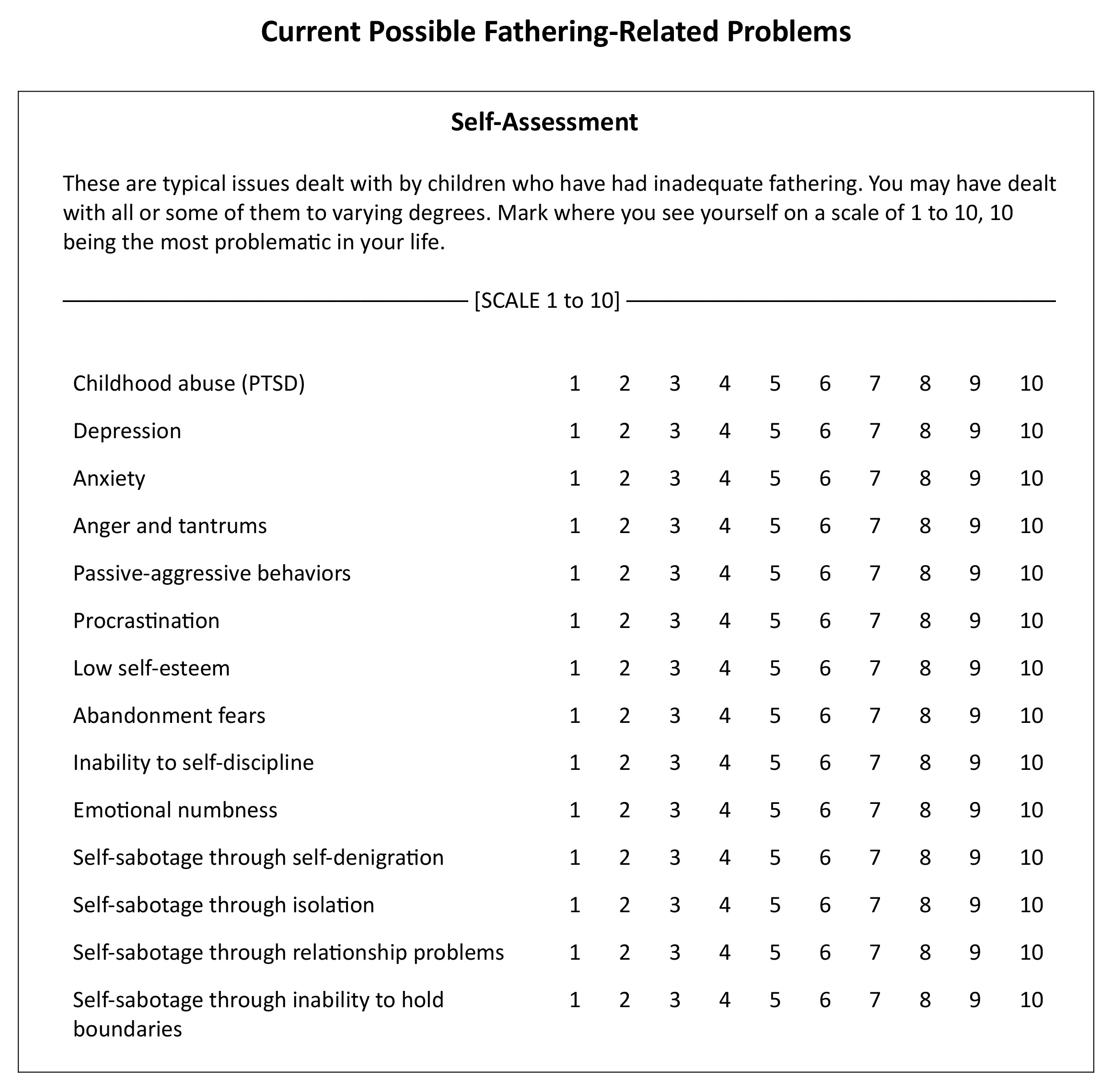
Current Possible Fathering-Related Problems
From Module 6: Your Inner Child
Limited Solutions
It is important to remember that your inner child is immature, with limited knowledge of life, but with real needs. His solutions to life were and are limited by childish thinking and are usually faulty and inappropriate for an adult. However, because these solutions and reactions were conditioned as neural pathways at such an early age, they have become go-to behaviors and reactions that are almost instinctive now.
Your inner child is most easily seen and experienced when you are sick, troubled, or feeling blue. Unable to change the way you feel, your inner child takes control and turns to self-soothing behaviors it knows will work, just like when you were a baby: eating, drinking, and fairy tale escapism. Only now the inner child’s solutions look like this: You’re stuffing yourself with muffins and ice cream, drinking too much with friends at a bar, or watching hours and hours of mind-numbing television. What worked for the child no longer benefits the adult.

Food was our first soothing mechanism—as babies at our mother’s breast—so no wonder we all have a “comfort food.” As adults who might be a bit overweight, we need to remind ourselves every now and then that just because a baby wants his candy, it does not mean you have to give it to him! What you do have to give him, however, is some kind of acknowledgment of his need and his suffering and some healthy soothing, the type that is both compassionate and responsible. In this case, it might be acknowledging his hunger and providing a nourishing snack rather than candy.
Your inner child can also bring you all kinds of good things. When you connect with your inner child, you can loosen up numbness, let go of years of self-imposed defenses, and begin to feel joy again. Your inner child can also point out specific tools of self-care that will work for you and you alone because they come from your oldest and deepest needs.
Identifying your inner child also helps you reconnect with childhood curiosity, with childhood joys and hobbies and passions, and this opens your senses to enjoying life again, too. If you are going to reparent yourself, and to do so with a gay father in mind, it is important that you also try to identify what brings (or brought) you joy in life, including any joyful experiences of inhabiting a male body. Your ideal gay father figure will want to support and encourage what makes your gay inner child happy.
You may also find that your inner child has elements that are not particularly likable. It is important to accept with self-compassion that you are a mix of all these things, and that you came into this world with much of that mix already way beyond your control. Recognize that you did the best you could at the time given what you were working with. We are not here to judge your inner child, only to recognize him and help him.
Reconnecting with Joy and Fun
- notepaper/pen or electronic notepad
- game/sport accessories as revealed
- Start with a 2-column grid. In the first column, list (in no particular order) the first games and sports and hobbies you liked to play as a very young child.
- In the second column, list the things about that particular game/sport/hobby that you liked.
- Add a few sentences at the bottom about what that says about your inner child.
- Pick one of the games/sports/hobbies on your list and play it with a friend. As you play, ask yourself if you still enjoy now what you enjoyed then?
From Module 12: The Great Misalignment
Misalignment in Eros (Life Force) and Libido (Sex Drive)
Do you feel alive in your male body? Do you feel good in and proud of your body? Do you enjoy its capacities and ability to bring joy? Do you know how to take care of it? It is our expectation, if not consciously then subconsciously, that our fathers will teach us how to be boys—how to use our bodies, how to train them, what to do with them when hormones start to change them, and how to enjoy them. After all, we share the same kind of body. On the surface, anyhow.

Unfortunately, many men in Western culture have difficulty being touched or sharing intimacies, especially with another man. Some teach their sons to be the same way. Seeing this attitude, the son infers that there is something shameful about the male body and the subject of sex. Body awareness may come later for these boys, when they start roughhousing with other boys, begin playing sports, or when they become teenagers, and the hormones start to flow and masturbation fantasies begin.
For a gay boy hiding in the closet just to stay safe, this silence and lack of touch can be doubly damaging to his relationship with his body and with sex in general. The lack of confirmation of his sexual attractiveness or the erotic physicality of his body can lead to chronic depression, self-hatred, eating disorders, sex or gym addiction, aversion to exercise, low self-esteem, sexual acting out, and so on. Body dysmorphia is rampant among gay men, unable to internalize the stamp of manhood no matter what shape the body is in.
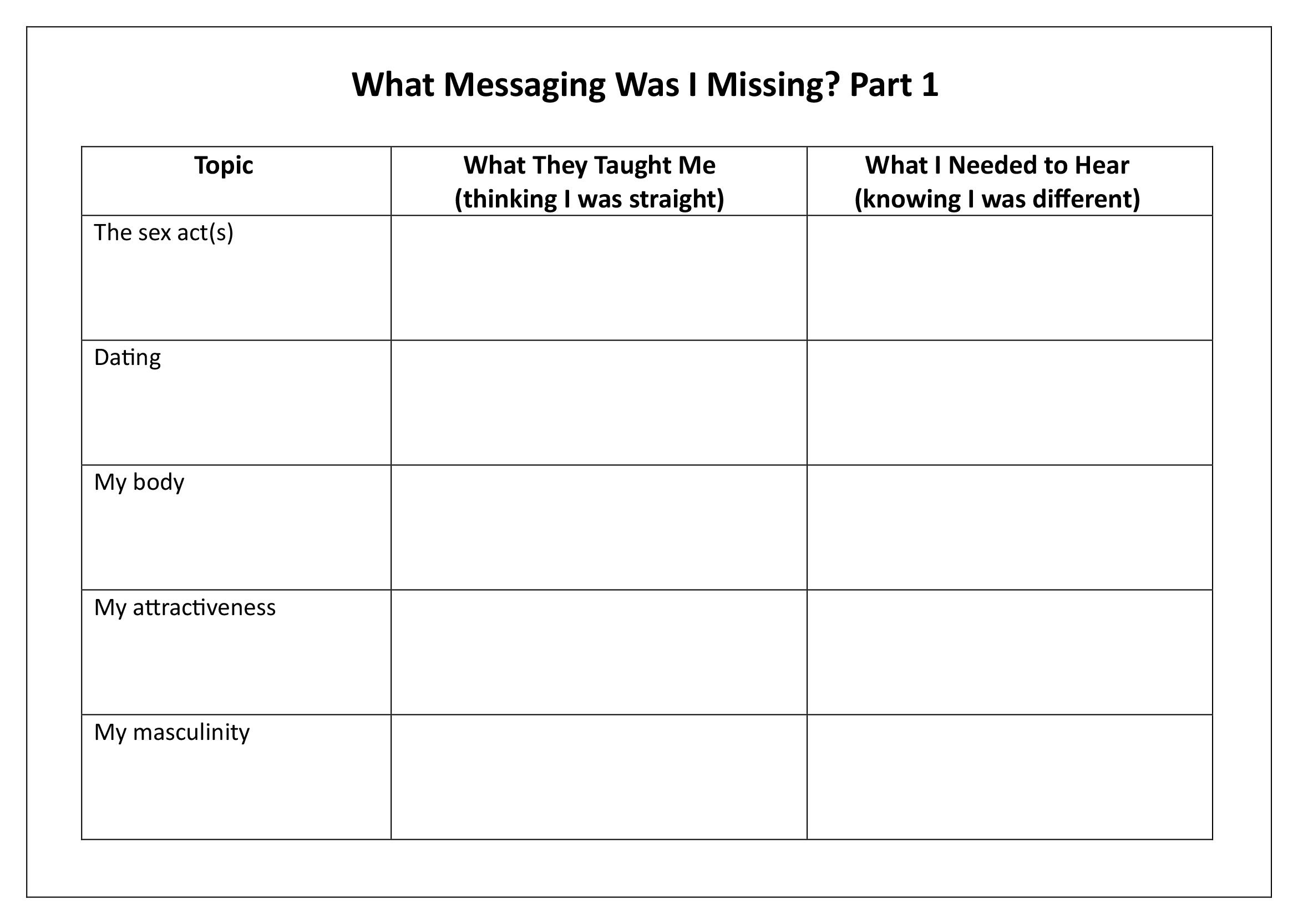
What Messaging Was I Missing? Part 1
Newsletter Signup
Sign up with your email address to receive periodic news and updates!